The fourth stage of the Novara Hills Trail takes the traveler from Cavallirio to Barengo along a route of approximately 20 kilometers, passing through woods, countryside, and one of the most surprising natural environments in the entire Novara territory: the Baragge del Piano Rosa Nature Reserve.
This is a predominantly flat stage, suitable for those wishing to immerse themselves in nature while discovering unusual landscapes and sites of great environmental and historical interest.
Departure from Cavallirio: history and countryside
The walk begins in the center of Cavallirio, a small village located at the foot of the Novara hills. After passing the parish church, the route heads towards the provincial road connecting the village to Boca, before quickly leaving the main thoroughfares to immerse itself in a more tranquil setting.
The route proceeds along secondary roads through cultivated fields and wooded areas, following a pleasant and relaxing itinerary. Along the way, you cross the Strona stream—a natural element that defines the local landscape—and pass several historic farmhouses that bear witness to the ancient agricultural heritage of this part of the Novara area.
The Baragge del Piano Rosa Nature Reserve
The true highlight of this stage is undoubtedly the Baragge del Piano Rosa Nature Reserve, a unique environment that surprises visitors with its unusual appearance.
After passing the Torba farmhouse, the road becomes a dirt track and the landscape changes completely. Tall grasses, scattered trees, and wide open spaces create a scenery that resembles, in some ways, an African savannah. It is one of the most evocative and characteristic locations along the entire Novara Hills Trail.
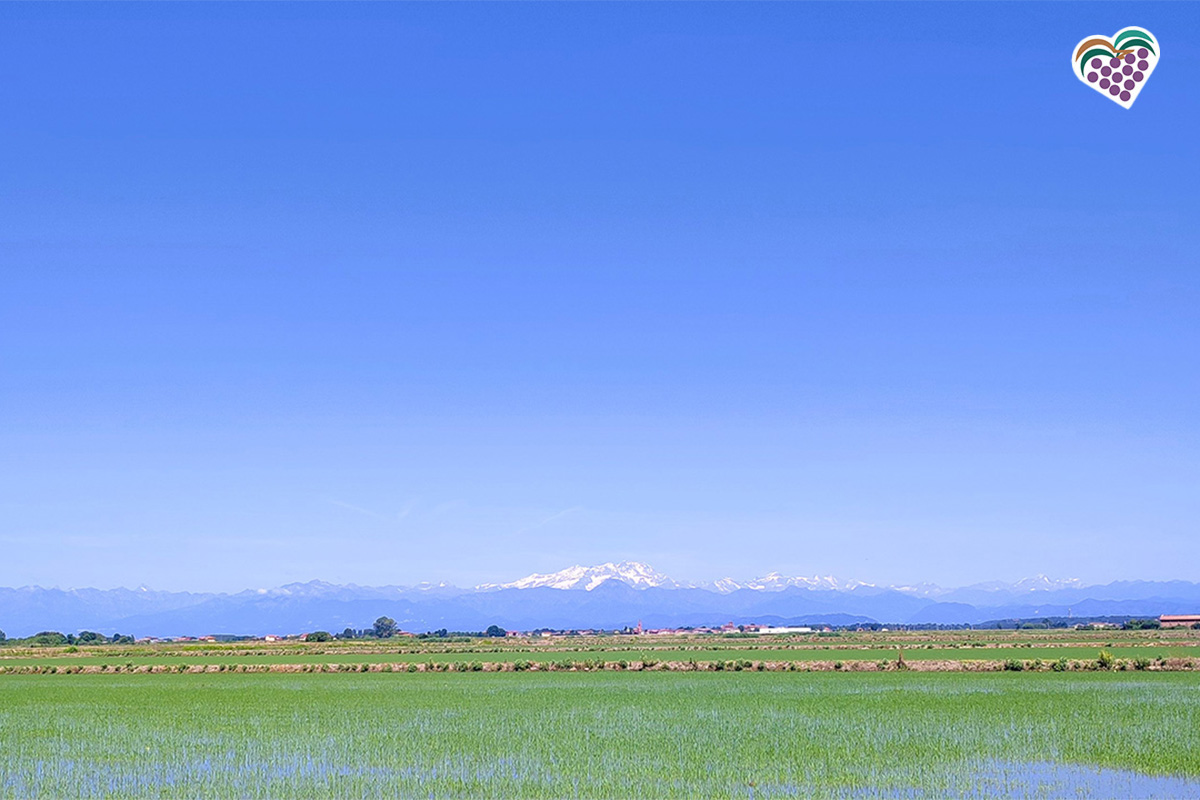
On clear days, the profile of Monte Rosa stands out on the horizon, creating a spectacular contrast between the wild environment of the Baragge and the Alpine peaks that dominate the panorama.
This ecosystem represents a rarity at the European level and is particularly appreciated by lovers of nature, photography, and birdwatching.
Among farmhouses and rural landscapes
Leaving the Reserve, the walk continues eastward, approaching the territory of Fontaneto d'Agogna. A detour allows you to reach the town center, while the main path continues through the countryside and rural roads that tell the story of the strong bond between these lands and agriculture.
Next, you reach the area of Cavaglio d'Agogna, another characteristic village of the Novara plains. Here too, a short detour allows for a visit to the historic center before returning to the official route.
The stage continuously alternates between natural environments and cultivated landscapes, offering a varied and never monotonous experience.
Arrival in Barengo, at the foot of the castle
The final part of the route leads towards Barengo, one of the most fascinating villages in the Lower Novara area.
The entrance into the village offers suggestive views of the historic center, dominated by the imposing castle that overlooks the town and represents one of the most recognizable symbols of the locality.
Among narrow alleys, historic buildings, and authentic atmospheres, Barengo is the ideal place to conclude this fourth day of walking, leaving behind the wild nature of the Baragge and preparing for the subsequent stages of the journey.
A stage through pristine nature and surprising landscapes
The stretch from Cavallirio to Barengo is one of the most unique parts of the Novara Hills Trail. The presence of the Baragge del Piano Rosa Nature Reserve makes this excursion a different experience from the rest of the itinerary, revealing an unexpected side of the Novara territory.
A route that alternates between silence, wide open spaces, rural farmhouses, and historical landmarks, ideal for those wishing to discover little-known natural environments of extraordinary charm.
This experience is ideal for guests of Hotel Ramoverde who wish to dedicate a day to discovering varied landscapes and ancient stories, fully experiencing the atmosphere of small villages and the Piedmontese countryside, while adapting the pace of the walk to their own needs and interests.